Sparklet vs LVGL: Key Differences Explored
Four dimensions that determine which framework is right for your production deployment.
MIT Open Source vs Royalty-Free Commercial
Both Sparklet and LVGL are royalty-free at deployment — you pay zero per-unit cost regardless of production volume. The licensing models differ structurally:
- LVGL: MIT open source — free for all uses, no licence fee whatsoever. The source code is public, the community is the support channel, and there are no vendor obligations.
- Sparklet: Royalty-free commercial — a fixed per-developer-seat licence covers the project. The source code is provided to customers. Zero per-unit cost at any production volume.
For consumer projects with no safety requirements, LVGL's zero cost is a genuine advantage. For teams that need professional support, safety documentation, and a formal vendor relationship — the Sparklet per-seat model is the trade-off for those capabilities.
Neither model imposes per-unit royalties. Both allow deployment on any number of production devices without additional licence payment. The cost difference is upfront seat licence vs zero.

Flint UI Designer vs SquareLine Studio
Both Sparklet and LVGL offer a visual design tool — but the depth of capability is significantly different.
SquareLine Studio provides drag-and-drop widget placement and basic screen layout generation for LVGL. It covers simple screen designs but has limited support for:
- Visual state machine authoring (transitions between screens based on application state)
- Full animation timeline with keyframe control and easing curves
- Figma asset import from UX design files
Flint UI Designer covers all of the above in a full WYSIWYG environment. A screen iteration in Flint — drag a widget, adjust its state machine transition, preview the animation — takes seconds. The same iteration in SquareLine or hand-coded LVGL takes a compile-flash cycle.
Across a product UI with 20–50 screens, animations, and navigation state machines, the productivity difference is weeks of engineering time. Flint's one-click C export targets all supported platforms without modification.
MISRA C Compliance — The Safety-Critical Dealbreaker
This is the most consequential difference for production deployments in regulated industries.
LVGL is not MISRA C compliant. Its codebase uses dynamic memory allocation, contains constructs that fail MISRA rules, and has not been through MISRA C static analysis certification. For automotive (ISO 26262 ASIL B/C), industrial (IEC 61508 SIL 2/3), and medical (IEC 62304 Class B/C) applications, this is a hard technical disqualification — not an advisory gap.
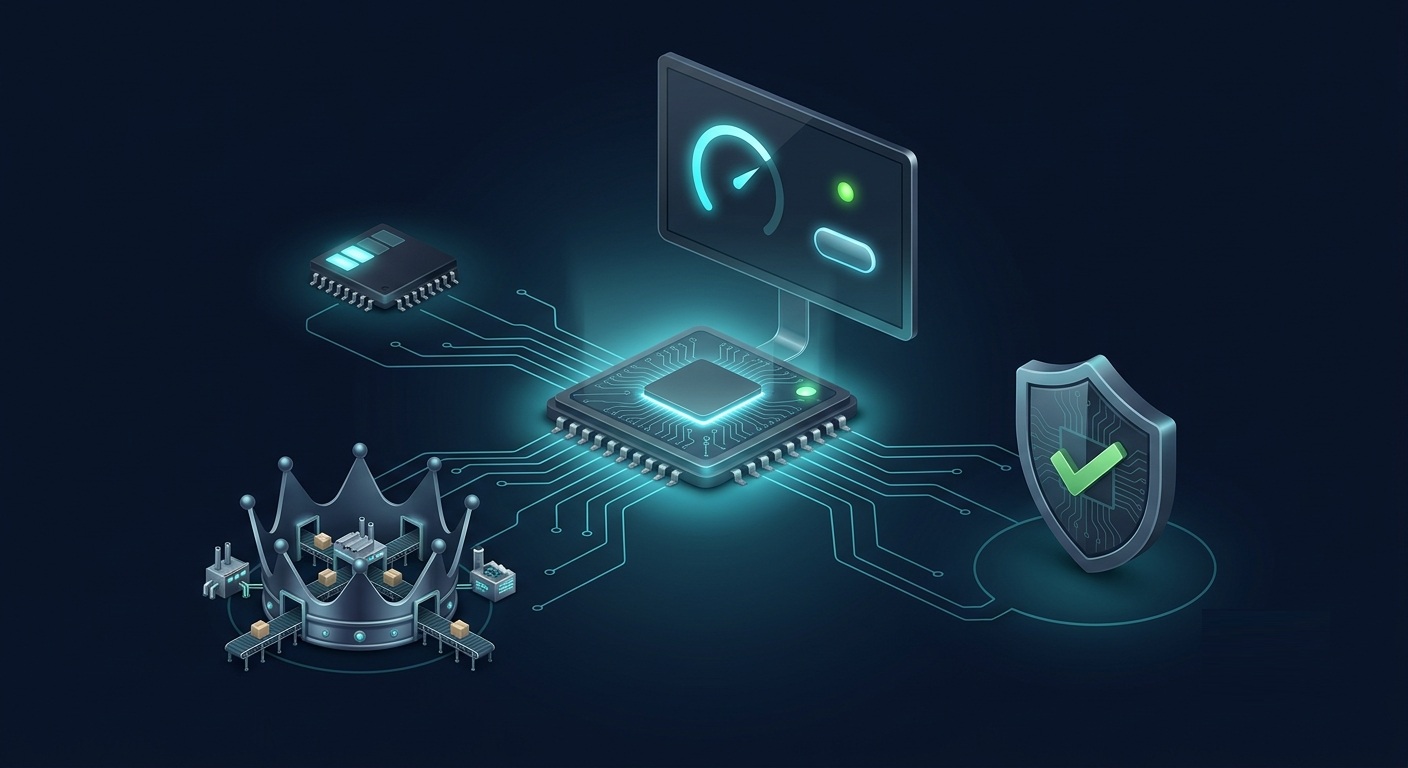
Sparklet's entire codebase is MISRA C compliant, with static analysis evidence and documentation available to customers. There is no other embedded GUI framework with full MISRA C compliance plus the breadth of platform and tooling support that Sparklet offers.
Beyond the compliance label, Sparklet's static memory architecture reinforces safety: no runtime heap allocation means no fragmentation, no allocator failure paths, and deterministic worst-case execution time (WCET) — requirements that safety standards often impose explicitly. See Safety-Critical Embedded HMI for detail.
Hardware Acceleration and Platform Coverage
Both frameworks support a wide range of 32-bit MCU and MPU targets. The difference is in acceleration depth and quality.
LVGL's hardware acceleration is community-contributed and varies in completeness across platforms. DMA2D, D/AVE2D, and Mali GPU integrations exist but may lag behind driver updates and require additional integration effort on specific hardware.
Sparklet's hardware acceleration integrations are developed and maintained by Embien's engineering team, with direct silicon vendor relationships. DMA2D and Chrom-ART (STM32), D/AVE2D (Renesas RH850), Mali-Limav GPU (RA8D1, i.MX 8), and sprite engine integrations are production-validated. Acceleration paths cover compositing, alpha blending, rotation, and scaling — not just basic fill operations.
On platforms where Sparklet has production-validated acceleration, the rendering performance is reliable and documented. See hardware acceleration and performance benchmarks.