Sparklet delivers embedded GUI library features designed specifically for resource-constrained MCUs and MPUs — not ported from desktop frameworks. Written in pure C with MISRA C compliance, royalty-free licensing, and a 7-layer architecture that cleanly separates widget, rendering, and hardware concerns, Sparklet gives engineering teams the performance, predictability, and tooling they need to ship modern embedded UIs on time.
Embedded GUI library features are the capabilities built into a graphics framework from the start — covering widget rendering, hardware abstraction, memory management, animation, and tooling. Unlike desktop GUI frameworks adapted for embedded use, a purpose-built library like Sparklet is architected around the constraints of MCU and MPU hardware: limited RAM (as low as 16 KB), no operating system guarantee, and strict real-time requirements.
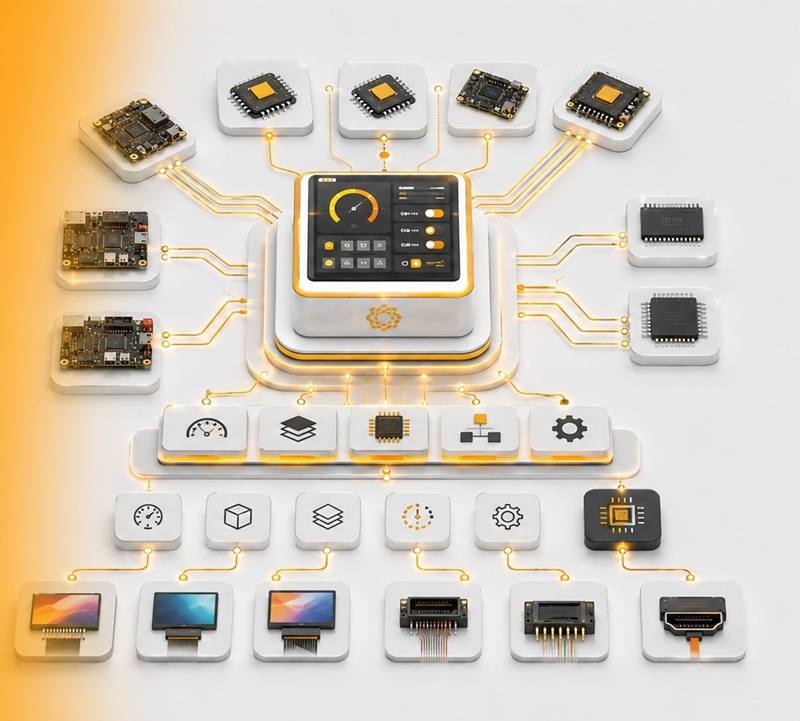
Sparklet's embedded GUI features span the full development stack. The WID layer provides 36+ production-ready widgets. The GDI layer handles rendering — routing pixel operations to software routines or hardware accelerators (DMA2D, D/AVE2D, PXP, Mali) depending on the platform. The HAL layer abstracts display drivers, touch controllers, and timers so the same UI code runs on Renesas, NXP, STM32, Infineon, Nuvoton, Rockchip, or a Windows simulator without modification.
Royalty-free per-developer-seat licensing means zero per-unit fees — a critical advantage for high-volume embedded deployments. The Flint UI Designer adds a no-code WYSIWYG environment that generates optimised C code directly, cutting development cycles by up to 70%.
Explore the capabilities across four key areas — widgets, rendering, design tooling, and platform support.
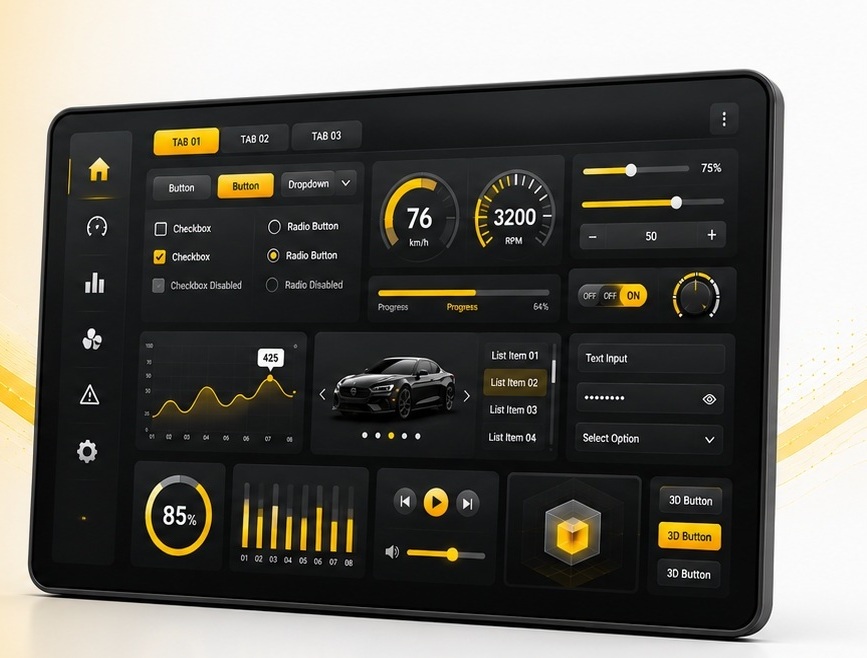
Sparklet ships with more than 36 pre-built UI components — every major category an embedded HMI needs out of the box. Input widgets: Button (Push/Toggle/Radio), CheckBox, Slider, RotaryKnob, TextEdit, SwipeButton. Selection and navigation: ListBox, ListView, ComboBox, Menu, Tab, TaskBar. Data visualisation: Graph (Line/Bar/Range), Meter, ProgressBar, Clock, Static, TextArea, ImageHolder. Containers: Window, Dialog, ScrollView, Viewport, GridView, Carousel, DotNavigator. Advanced: 3DWidget, 3DView, Keyboard, CustomWidget.
Every widget supports property-based data binding, event callbacks, animation, and custom styling — eliminating weeks of from-scratch development. All widgets are accessible from Flint UI Designer by drag-and-drop.
Sparklet's GDI (Graphics Device Interface) layer provides three rendering modes that scale from ultra-low-cost MCUs to high-performance MPUs:
All three modes share the same widget API. Moving from software to hardware-accelerated rendering requires only a HAL and build configuration change.

Flint UI Designer is Sparklet's PC-based drag-and-drop design environment. The full workflow: Design — drag widgets onto a pixel-perfect canvas, set properties, import assets from PNG/JPG/Figma. Connect — wire up UML-based state machines visually, bind data properties to widget attributes, define transitions and guards. Deploy — export optimised, platform-agnostic C code with a single click.
Key capabilities: live preview on the PC simulator; import .obj/.fbx 3D models; Unicode and RTL language support; CarPlay/Android Auto screen-mirroring protocol support; ADAS live camera feed integration. Customers consistently report reducing development cycles by 50–70% vs hand-written widget code.

Sparklet runs on nine hardware platforms with native HAL support: Renesas RH850, RA6M3, RA8D1; NXP i.MX RT1170, i.MX 8; STM32 F4/H7/U5; Infineon TRAVEO T2G; Nuvoton Gerda-ZWEI; Rockchip RK3506G2; plus Windows x86 and Linux SDL2 simulators for development and testing.
RTOS support covers: FreeRTOS, Azure RTOS ThreadX, Zephyr, QNX, ITRON, Embedded Linux, Android AOSP, and bare-metal single-loop. The EXEC layer drives a single-task rendering model; RTOS tasks post data updates to a queue drained at frame-start — eliminating race conditions on widget state.
Every capability below was designed for embedded systems from day one — not backported from a desktop framework.
Written entirely in pure C. Full MISRA C compliance validated by static code analysis tools — mandatory for automotive ISO 26262, medical IEC 62304, and industrial IEC 61508.
Developer-seat model. Zero per-unit fees regardless of production volume. Deploy on 10 units or 10 million — licensing cost is fixed. Dramatically better ROI than per-unit royalty competitors.
GDI layer routes pixel ops to DMA2D (STM32), D/AVE2D (Renesas), PXP (NXP), or Mali GPU. CPU freed for application logic. 60 fps on STM32H7 at WVGA resolution.
Modular architecture — include only the widgets and rendering features you use. Single-screen configurations run in 16 KB. Partial buffer mode eliminates the second full-screen framebuffer.
APP→WID→GDI→EXEC→RS_MIN→UTIL→HAL. Each layer communicates only through defined C APIs. A new hardware platform port requires only a HAL change — no widget or application code changes.
Only changed widget bounding rectangles are redrawn each frame. 80–95% of pixel operations skipped on typical HMI screens. Enables software rendering at 60 fps on mid-range MCUs.
RS_MIN hierarchical state machine engine (HSM) evaluates UML state machines generated by Flint. Guards, entry/exit actions, and data binding are all executed in a deterministic order each frame.
Full Sparklet stack runs on Windows x86 and Linux SDL2. Design, test, and debug on the PC before hardware is available. Measure frame rates and memory usage in simulation before committing to silicon.
| Feature | Sparklet | LVGL | Qt for MCUs | TouchGFX |
|---|---|---|---|---|
| Language | Pure C | C (limited C++) | C++ | C++ |
| MISRA C Compliance | Full | Partial | No | Partial |
| Licensing | Royalty-free (dev seat) | MIT open source | Per-unit royalty | Free (STM32 lock-in) |
| No-Code Design Tool | Flint (full WYSIWYG) | SquareLine Studio (basic) | Qt Design Studio | TouchGFX Designer |
| Hardware Acceleration | DMA2D, D/AVE2D, PXP, Mali | DMA2D, PXP (partial) | GPU (platform-dependent) | DMA2D, Chrom-ART |
| Minimum RAM | 16 KB | ~20–40 KB | ~300 KB+ | ~100 KB |
| Platform Independence | 9+ vendors, HAL-only change | Good (open source) | C++ overhead limits MCUs | STM32 primarily |
| State Machine Engine | Built-in HSM (RS_MIN) | None built-in | QML state machine | Screen transitions only |
An embedded GUI library is a software framework that provides widget rendering, input handling, animation, and hardware abstraction for graphical user interfaces running on MCUs and MPUs. Unlike desktop GUI frameworks, an embedded GUI library is designed to operate within strict RAM, Flash, and CPU budget constraints — often without a standard operating system. Sparklet is an embedded GUI library written in pure C, with a 16 KB minimum RAM footprint and support for bare-metal, RTOS, and Linux environments.
Get the free evaluation binary for your target platform — includes Flint UI Designer, sample projects, and full widget library. No royalties. No per-unit fees.