Sparklet Across Home Appliance Categories
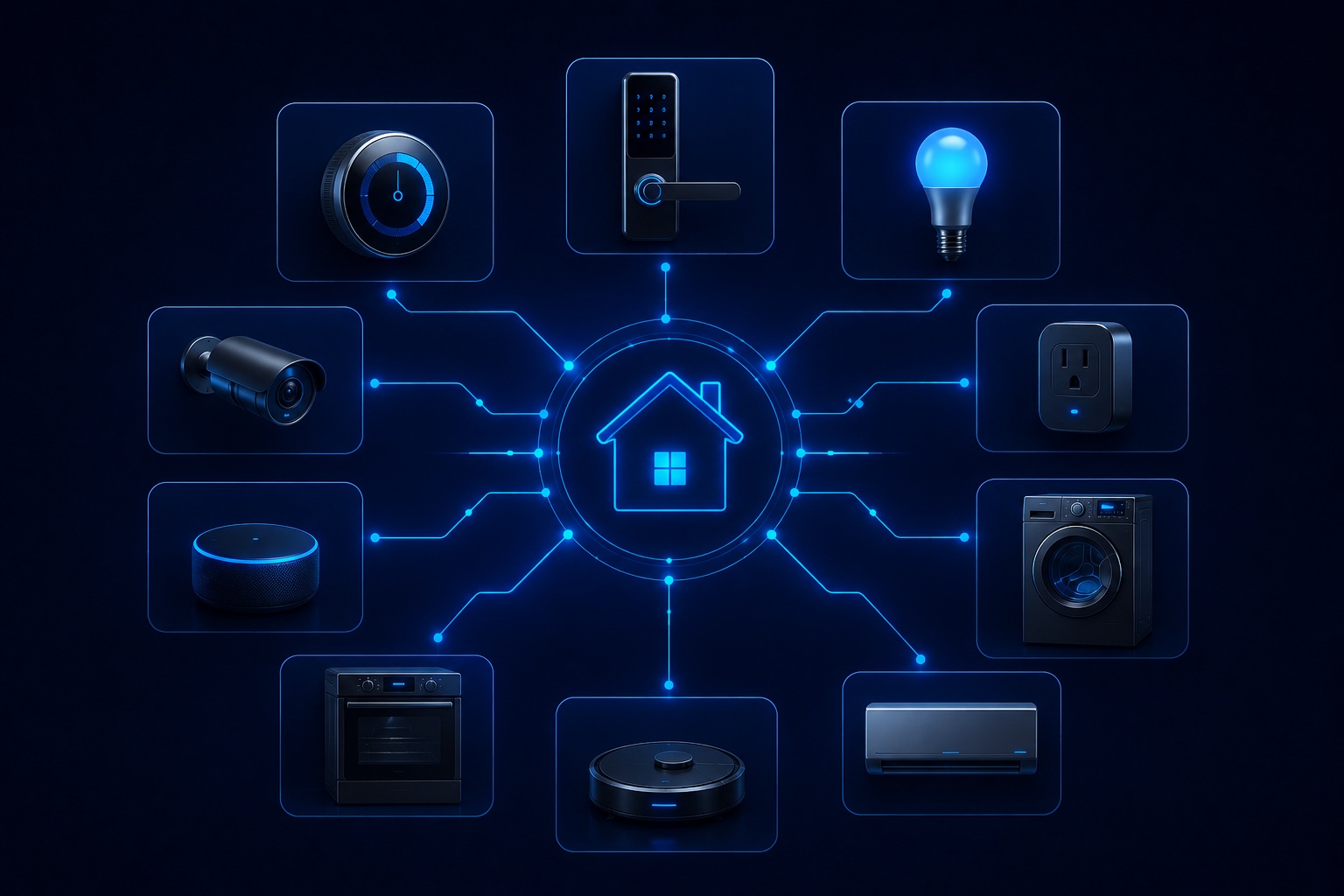
Washing machines, refrigerators, ovens, air conditioners, and coffee makers increasingly feature full-colour touchscreen displays that consumers expect to feel premium. Sparklet delivers consumer-quality animated UIs on the cost-effective, low-RAM MCUs that home appliance bill-of-materials demands — and its royalty-free licensing model means zero per-unit cost across millions of shipped appliances.
Home appliance embedded GUI refers to the touchscreen or button-driven display interface on consumer white goods — washing machines, refrigerators, ovens, dishwashers, air conditioners, and smart kitchen appliances. These displays are part of the broader smart appliance movement: once a simple LED or seven-segment indicator, today's appliance display is a full-colour capacitive touch panel expected to look and feel as polished as a smartphone.
The engineering challenge is that home appliance cost structures are extremely sensitive. A BOM increase of even a few cents per unit becomes significant at millions of units per year. The MCU in a washing machine or refrigerator is often a low-cost 32-bit device with 64–256 KB RAM — a far cry from the desktop-derived framework assumptions of Qt or the mid-range MCU targets of some GUI libraries. The GUI framework must deliver consumer-grade visual quality within these resource constraints, and must be licensed in a way that scales to appliance production volumes without per-unit cost compounding.
Sparklet is purpose-built for exactly this environment: 16 KB minimum RAM footprint, pure C with no heap dependencies in the render path, royalty-free per-developer-seat licensing, and the Flint UI Designer tool that enables non-programmer product designers to create polished appliance UIs without writing C code.
Licensing cost is a first-order concern in home appliance embedded GUI selection — not because any one royalty payment is large, but because the math at appliance production volumes is unforgiving. Understanding how different licensing models scale is essential for any engineering manager building a business case for a GUI framework change.
Some embedded GUI frameworks charge a per-unit royalty on every device shipped using the framework. At industrial volumes — a few hundred machines per year — this is manageable. At appliance volumes — 500,000 units per year for a single SKU, potentially millions across a product range — the cost compounds rapidly. A per-unit royalty of even USD 0.50 per unit becomes USD 250,000 per year for a single product line at 500K units. This cost grows proportionally as the product scales to international markets. It is an ongoing obligation with no ceiling, payable on every device shipped for the product lifetime.
Qt for MCUs uses a per-developer-seat plus per-unit royalty model for commercial embedded deployment. The per-unit royalty applies to every device shipped with a Qt for MCUs-based UI. At appliance volumes, this is a significant and growing cost. Qt also requires C++ compilation — which adds flash footprint compared to a pure-C framework and excludes MISRA-C compliance as a practical option.
LVGL's open-source MIT license appears zero-cost but has conditions for commercial appliance deployment (particularly around trademark and support). LVGL's commercial licensing for support and warranty introduces a different cost model. More practically, LVGL's design workflow is code-centric — product designers without C skills cannot iterate the appliance UI independently of the firmware engineer, which slows the design cycle.
Sparklet is licensed per developer seat — a fixed annual or perpetual license per engineer who works on the Sparklet UI project. Every unit shipped using that engineer's Sparklet build carries zero additional GUI licensing cost. At 500,000 units per year, the GUI framework cost is identical to what it was at 100 units. A team of 3 developers working on a washing machine UI pays for 3 seats, regardless of how many washing machines ship. This is the economically correct model for high-volume consumer electronics. See Why Choose Sparklet for a detailed licensing comparison.
For products shipping very small quantities — fewer than a few hundred units — where the per-unit royalty economics are not a concern, a runtime license option is available. Contact Embien to discuss the appropriate licensing tier for your specific production volume.
| Feature | Smart Range / Dishwasher | Thermostat / AC | Security Panel | Sparklet Supports |
|---|---|---|---|---|
| Full-colour TFT rendering | Required | Required | Required | Yes — software 2D / DMA2D / hardware-accelerated |
| Capacitive touch | Required | Required | Required | Yes — event-driven touch API |
| Animated progress / countdown | Required (cycle progress) | Optional | Optional | Yes — animated ProgressBar and Clock widgets |
| Carousel / programme selector | Required | Optional | Not used | Yes — Carousel widget |
| Rotary / dial control | Optional | Required (temperature) | Optional | Yes — RotaryKnob widget |
| Display idle / backlight off | Required | Required | Required | Yes — display-idle API, configurable timeout |
| Multi-language (incl. Arabic) | Required (global models) | Required | Optional | Yes — full Unicode, design-time Arabic shaping |
| FreeRTOS / bare metal | Either | Bare metal common | FreeRTOS common | Yes — both supported; cooperative RTOS task |
| Royalty-free at volume | Critical (millions of units) | Important | Important | Yes — developer-seat model, zero per-unit cost |

Sparklet's developer-seat licensing means every washing machine or refrigerator you ship carries zero GUI licensing cost. At a million units per year, this is a decisive BOM advantage.
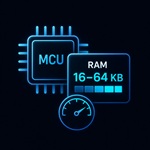
Cost-effective appliance MCUs have limited RAM budgets. Sparklet operates with as little as 16 KB RAM — leaving the majority of available memory for application logic, sensor data, and connectivity stacks.

Carousel, animated ProgressBar (linear and circular), and smooth screen transitions give home appliance UIs the polished, modern look consumers expect — running efficiently on STM32, Nuvoton, or Renesas RA MCUs.

Flint UI Designer's drag-and-drop interface allows industrial designers and UX teams to build and iterate appliance screens without writing C code. Flint exports the embedded C automatically.
Home appliances use embedded GUI frameworks designed for cost-effective 32-bit MCUs with 64–512 KB RAM. Sparklet is well suited: it operates with as little as 16 KB RAM, runs on STM32, Nuvoton, and Renesas RA appliance MCUs, provides animated widgets for consumer-quality UIs, and is licensed royalty-free — essential for high-volume appliance production where per-unit licensing costs compound at scale.
Download the Sparklet evaluation binary and Flint UI Designer. Prototype your washing machine, refrigerator, or smart kitchen appliance display on Windows before deploying to your target MCU hardware.