EV Charging Station Display GUI — Built for Scale and Performance

Deploy attractive, multi-language, royalty-free embedded UIs on EV charging stations worldwide. Sparklet renders real-time charge progress, payment flows, and energy data on STM32, NXP i.MX RT, and Nuvoton MCUs — with zero per-unit licensing cost no matter how many chargers you ship.

What is an EV Charging Station Display GUI?

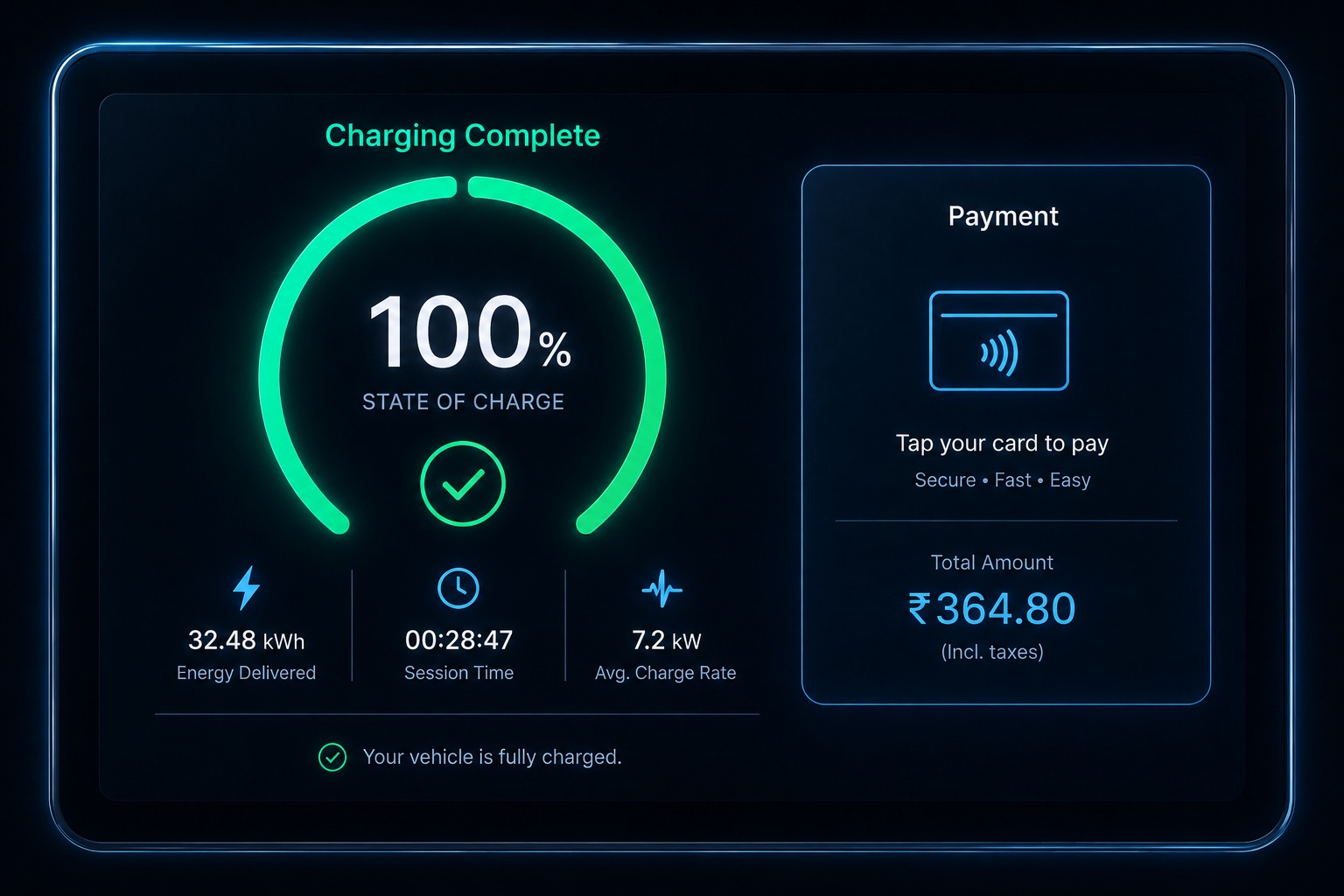
An EV charging station display GUI is the embedded touchscreen interface on a public or home electric vehicle charger that guides the driver through a charging session — from vehicle connection and authentication to real-time charge progress monitoring, energy consumed, estimated completion time, and payment processing. A well-designed EV charger HMI must be intuitive for first-time users, readable in direct sunlight, responsive to glove touch in outdoor environments, and capable of displaying content in multiple languages for public infrastructure deployments.

Sparklet provides an ideal embedded GUI foundation for EV charging station displays. Its low memory footprint runs comfortably on the cost-effective MCUs that charger manufacturers favour, its royalty-free licensing eliminates the per-unit cost that makes commercial GUI frameworks economically unviable at charging network scale, and its built-in multi-language Unicode support handles internationalisation needs without additional integration work. For broader smart display context, see the consumer electronics and smart displays page.

EV Charger Display Scenarios

Three display use cases Sparklet handles out of the box.

Real-Time Charge Progress Visualisation

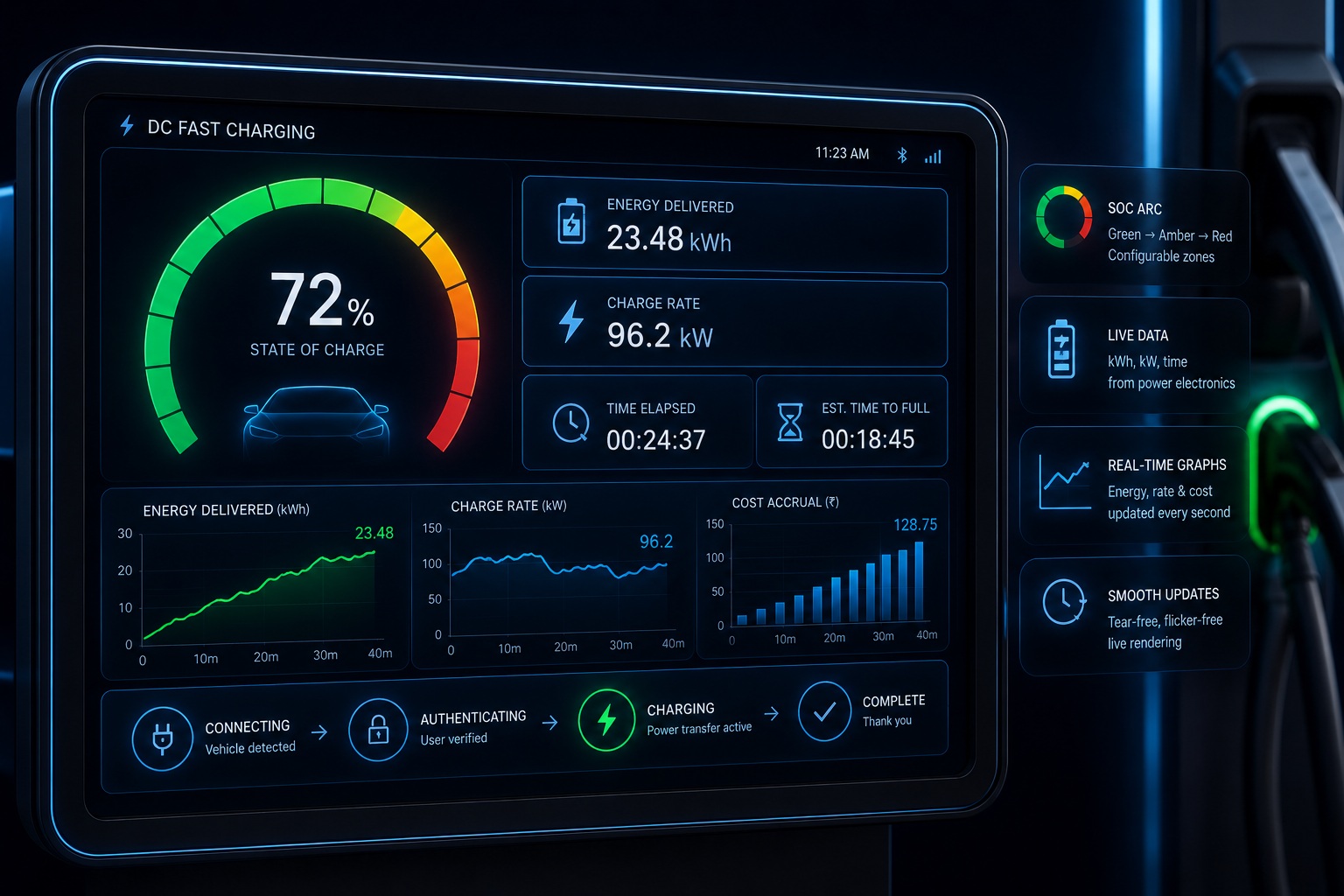
Drivers expect a smooth, live-updating charge percentage arc, kilowatt-hour counter, estimated completion time, and charge rate (kW) — all updating from the charger's power electronics measurements every second.

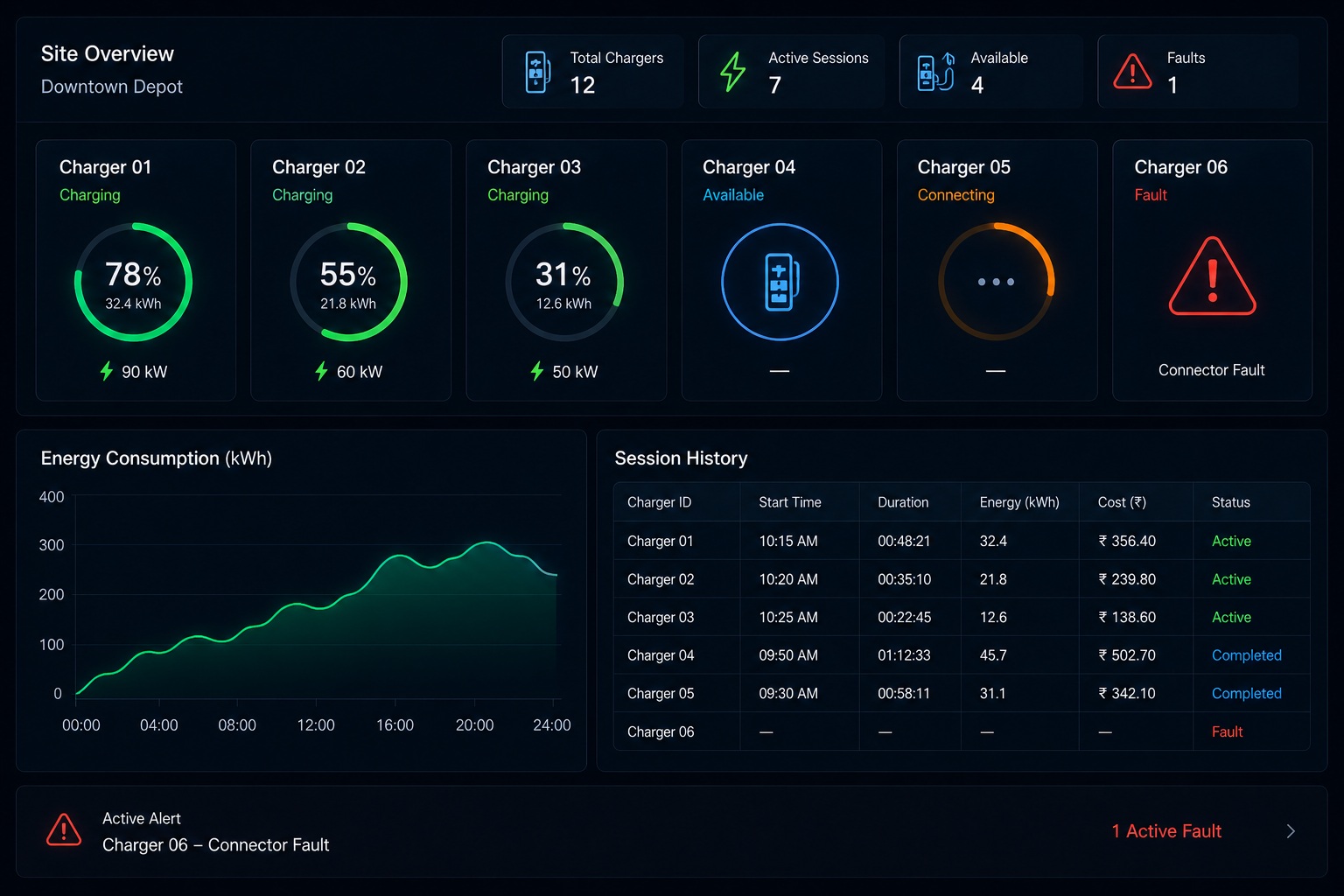
Sparklet's ProgressBar widget renders circular arc or linear fill charge-percentage indicators that update live without tearing or flicker. The Graph widget (line and bar modes) plots energy delivered over session time, charge rate history, and cost accrual — all from a simple API call with the latest meter reading.

  • Circular SOC arc with configurable green → amber → red colour zones
  • Live kWh counter and charge rate display from power electronics CAN data
  • Animated session timer and estimated time-to-full indicator
  • Smooth state transitions: connecting → authenticating → charging → complete
Why Royalty-Free Licensing Is an Economic Requirement for EV Charger Manufacturers

A charging network that ships 50,000 chargers per year with a per-unit GUI licence pays that fee on every single unit — every year the network grows. At even a modest per-device rate, this becomes a substantial recurring software cost that scales with every charger shipped. Sparklet's developer-seat model means you pay once per engineer on your display firmware team and deploy on every charger you build, forever.

For a charging network manufacturer, this is typically a significant annual saving compared to commercial GUI frameworks with per-unit royalty models. The economic case for royalty-free licensing becomes even stronger when you consider the hardware context: charger display MCUs are cost-optimised components selected for tight BOM targets. A GUI framework that requires an MCU upgrade to a larger memory variant to deliver acceptable visual quality adds cost at the hardware level as well. Sparklet runs a complete charging session UI in under 64 KB RAM on STM32H7 or NXP i.MX RT1170 — meaning the display subsystem does not force an MCU upgrade. See Sparklet's memory benchmarks for charger-class hardware figures.

The royalty-free economics are paired with a modern design toolchain. Sparklet's Flint UI Designer allows the HMI team to update charging session screens, adjust branding elements, and iterate payment flow layouts without involving the firmware engineering team for routine cosmetic changes — reducing the cost of ongoing display maintenance across a multi-year charging network lifecycle.

EV Charging Station HMI Feature Checklist

Display FeatureRequired bySparklet Support
Circular charge progress arcAll charger tiersProgressBar widget; circular arc mode; HW-accelerated fill
Live kWh / kW / time countersOCPP metering displayStatic + TextArea widgets; CAN/OCPP data binding in Flint
Session state transitionsUser journey UXFlint state machine editor; C code export
RFID / QR / card payment UIPayment protocol integrationStatic (QR image), Dialog (auth prompt), full flow in Flint
Multi-language interfacePublic network deploymentFull Unicode; RTL + CJK; single firmware, runtime switch
Sunlight-readable contrastOutdoor installationHigh-contrast theme; brightness API; configurable palette
Low-power idle / attract modeEnergy efficiency requirementDirty-region rendering; display blanking API; attract loop
Royalty-free volume deploymentNetwork economicsPer-developer-seat licence; zero per-unit cost
STM32H7 / i.MX RT / Nuvoton MCUBOM cost optimisationValidated HALs for all three; < 64 KB RAM for full UI

Four Reasons EV Charger Manufacturers Choose Sparklet

From real-time charge visualisation to royalty-free economics — the EV charger HMI requirements Sparklet was designed to meet.
Charge Progress

Real-Time Charge Visualisation

ProgressBar and Graph widgets update live from power electronics data — charge arc, energy counter, rate, and time-to-full — with smooth animation and no rendering artefacts on budget MCUs.

Multi-Language EV

Multi-Language for Global Networks

Full Unicode with RTL and CJK in a single firmware build. Language switching is one API call — no separate per-locale firmware images for international charging network deployments.

Royalty Free EV

Zero Per-Unit Royalty at Any Scale

Deploy on 500 or 500,000 chargers — the licensing cost does not change. The only viable GUI economics for charging network manufacturers with large annual shipment volumes.

Budget MCU

Runs on Cost-Optimised Charger MCUs

Complete charging session UI — progress arc, payment flow, multi-language text, animation — within 64 KB RAM on STM32H7 or NXP i.MX RT1170. No MCU upgrade; BOM cost stays optimised.

FAQs: EV Charging Station Display GUI

The most common EV charger display MCUs are STM32H7 (DMA2D/Chrom-ART), NXP i.MX RT1170 (PXP accelerator), and Nuvoton series MCUs. Sparklet has validated HAL implementations for all three, with example charger UI projects available for STM32H7 and i.MX RT1170. Contact Embien for support on other charger MCUs not listed.

Evaluate Sparklet for Your EV Charger Display Project

Download the Sparklet evaluation binary for STM32H7 or NXP i.MX RT1170, load the charging station demo project in Flint, and see a complete charge session UI on your hardware — royalty-free, from day one.