Feature-Rich Digital Instrument Cluster for Performance Motorcycles on RH850 with Sparklet
Introduction
Modern motorcycles are rapidly evolving into intelligent mobility platforms that combine performance, connectivity, and advanced rider interfaces. Riders today expect more than basic vehicle data from their instrument clusters. They require real-time performance insights, navigation assistance, connectivity features, and personalized riding experiences delivered through an intuitive and visually engaging display.
To address these evolving expectations, a leading Tier1 approached Embien Technologies to develop a next-generation digital instrument cluster for a performance motorcycle platform. The goal was to design a feature-rich and responsive rider interface capable of presenting critical riding information alongside advanced connectivity and telemetry features.
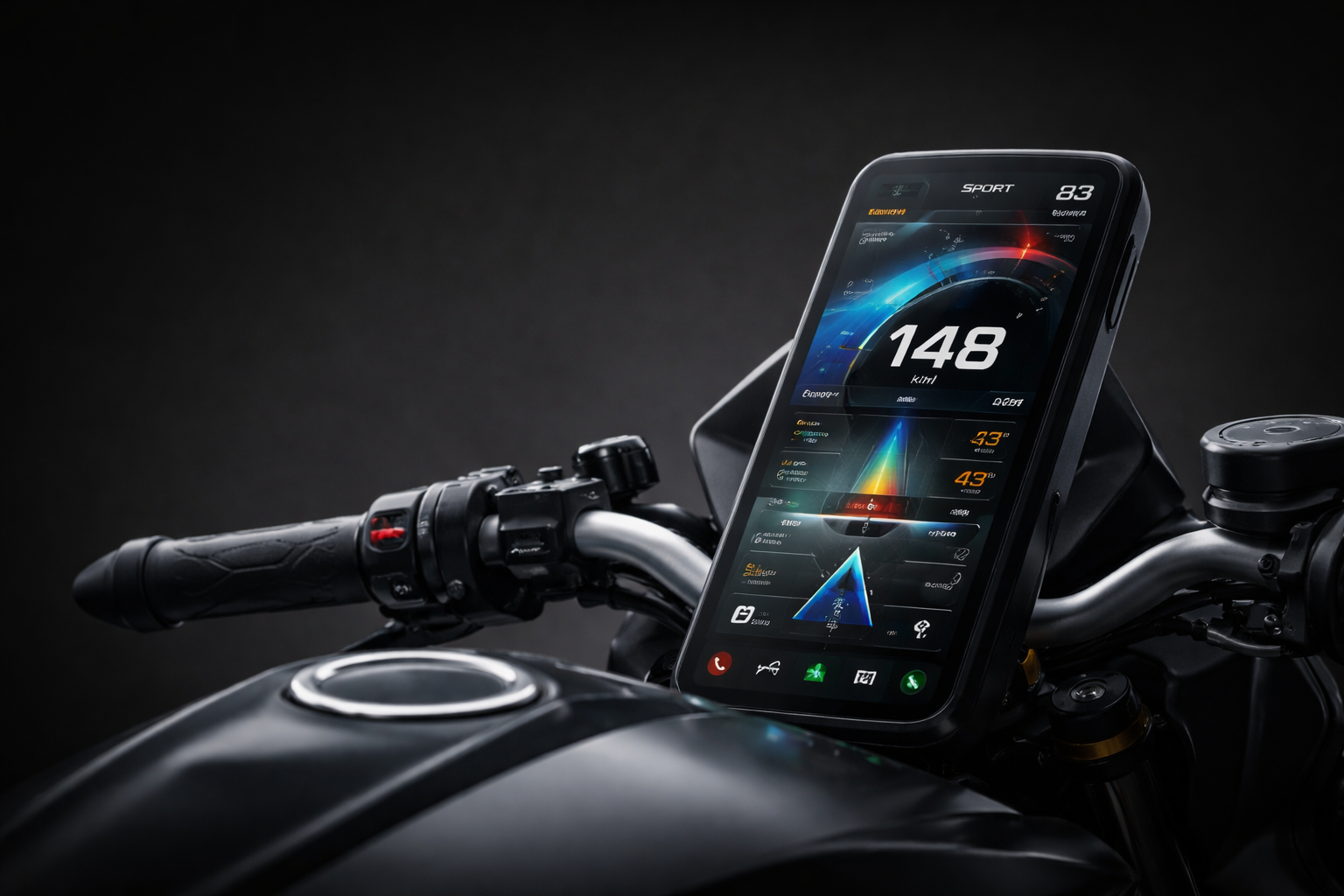
The system was built around the Renesas RH850 microcontroller and a TFT display, enabling the cluster to deliver smooth graphics, dynamic animations, and responsive interactions within the constraints of an embedded automotive platform. Using Embien’s Sparklet Embedded GUI framework, the development team created a visually engaging cluster capable of supporting multiple riding modes, multilingual interfaces, navigation, voice assistance, and connected services.
The resulting solution transforms the instrument cluster into an intelligent rider information system that enhances both riding experience and operational awareness.
Challenge
Developing a modern digital instrument cluster for performance motorcycles involves balancing advanced graphical capabilities with the limitations of embedded automotive hardware. The system must deliver visually rich interfaces while maintaining reliable and deterministic performance under real-world riding conditions.
One of the primary challenges was designing a user interface that could support multiple riding modes while maintaining clear visibility of essential riding information. Each riding mode required distinct visual themes and animated transitions that allow riders to instantly recognize the active mode without distracting them from critical data such as speed, gear position, and warning indicators.
Another key challenge involved integrating performance-oriented telemetry features such as lap timing and lean-angle visualization. These features must update dynamically in real time while preserving graphical smoothness and system responsiveness.
The cluster also needed to incorporate connected vehicle features including turn-by-turn navigation, music playback control, call and message notifications, and smartphone integration. These elements had to be presented in a structured manner so that riders could access additional information without overwhelming the primary display area.
Multilingual support introduced additional design complexity. The interface needed to support multiple European languages—including English, French, German, Dutch, Portuguese, and Spanish—while maintaining consistent layout and readability across varying text lengths.
Furthermore, the system required integration of emerging rider convenience features such as voice assistance and digital document viewing. These functions expand the role of the instrument cluster beyond traditional vehicle monitoring, turning it into a central rider interaction interface.
Finally, the entire solution had to remain optimized for the RH850 microcontroller platform while ensuring smooth animations, efficient memory usage, and reliable performance under vibration, outdoor lighting, and temperature variations typical of motorcycle environments.
Solution
To address these requirements, Embien designed a digital instrument cluster architecture centered on the Sparklet Embedded GUI framework running on the Renesas RH850 platform. This architecture enabled the development of a visually rich interface while maintaining efficient resource utilization.
The user interface was designed with a clear visual hierarchy to ensure that essential riding information remains immediately visible. Core parameters such as speed, gear position, warning indicators, and system status occupy the primary viewing area, while secondary information such as navigation guidance, connectivity features, and notifications are displayed in dedicated interface regions.
Sparklet’s optimized rendering pipeline enabled smooth graphical transitions and animated elements throughout the cluster interface. Each riding mode features unique color schemes and animated transitions that visually communicate the selected configuration to the rider. These animations provide a clear contextual indication of the active riding profile while maintaining a cohesive interface design.
The cluster supports five riding modes—Sport, Supermoto, Urban, Rain, and Track—each offering a tailored visual theme and layout emphasis suited to the intended riding conditions. Animated transitions between modes enhance the rider experience while preserving system responsiveness.
Advanced telemetry capabilities were implemented through dedicated performance screens that display lap timing metrics and lean-angle indicators. These features provide valuable insights into riding dynamics and performance behavior, particularly during spirited riding scenarios.
To enhance connectivity and convenience, the cluster integrates smartphone-based features such as music playback controls, incoming call notifications, and message alerts. These notifications are presented through unobtrusive overlays that allow riders to remain informed without diverting attention from the road.
Turn-by-turn navigation support is provided through split-screen layouts that display directional guidance alongside core riding information. This design allows riders to follow navigation instructions without sacrificing visibility of essential vehicle data.
The cluster also incorporates voice assistance capabilities, enabling riders to interact with selected system functions using voice commands. This hands-free interaction improves convenience while supporting safer rider interaction with connected features.
Another notable feature is the integrated document viewer that allows riders to access digital versions of important documents such as vehicle registration certificates and driving licenses. This functionality supports modern digital documentation practices and enhances rider convenience.
Multilingual capabilities were implemented using a flexible localization framework that dynamically adapts UI elements to support multiple languages while maintaining consistent layout integrity.
Using Flint IDE, Embien’s visual UI design environment, the development team rapidly prototyped and optimized screen layouts. This tool enabled seamless integration between UI design and runtime implementation, accelerating development while ensuring optimal graphical performance.
Performance and Results
The final digital instrument cluster delivers a highly responsive and visually engaging rider interface optimized for performance motorcycles. Sparklet’s efficient rendering architecture enables smooth animations and real-time telemetry updates while maintaining low CPU utilization on the RH850 platform.
Mode transitions, animated gauges, and interface elements operate fluidly, providing riders with an intuitive and immersive visual experience. The optimized rendering pipeline ensures that only updated portions of the display are refreshed, reducing processing overhead and improving system efficiency.
The cluster demonstrates reliable real-time performance even when handling multiple UI layers including telemetry displays, navigation overlays, notifications, and animated ride mode transitions. The multilingual architecture allows the same software platform to support multiple regional markets without requiring significant software modifications, simplifying product deployment across international markets.
Environmental validation confirmed stable operation under vibration, temperature changes, and varying lighting conditions typical of motorcycle operation. The display remains clearly readable in outdoor environments while maintaining consistent graphical performance.
Overall, the solution successfully combines modern digital dashboard capabilities with the reliability and efficiency required for automotive embedded systems.
Conclusion
As motorcycles continue to integrate advanced electronics and connected technologies, the instrument cluster is becoming a central interface for rider interaction and vehicle information. Delivering a visually sophisticated yet reliable cluster requires careful integration of hardware capabilities, optimized graphics frameworks, and intuitive UI design.
By leveraging the Renesas RH850 microcontroller and Sparklet Embedded GUI framework, Embien developed a feature-rich digital instrument cluster capable of delivering advanced rider experiences including animated ride modes, telemetry visualization, navigation integration, voice assistance, and connected services.
The solution demonstrates how optimized embedded graphics technology can enable modern digital dashboards while maintaining the efficiency and stability required for automotive environments. With scalable architecture and flexible UI capabilities, the platform provides a strong foundation for future motorcycle cluster innovations.