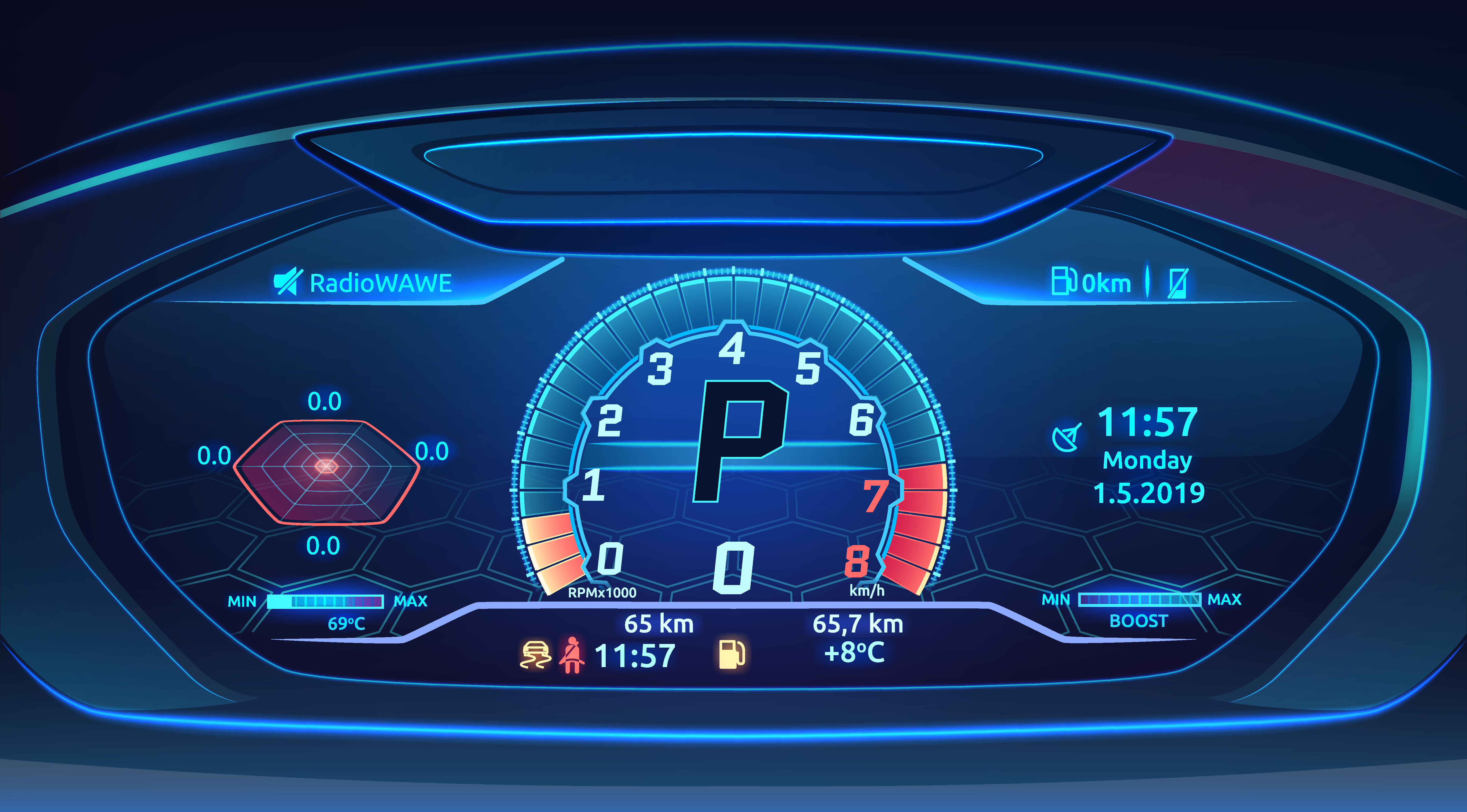
In today's connected world, the demand for rich, responsive, and visually appealing graphical user interfaces (GUIs) in embedded systems has exploded. From automotive digital clusters to industrial HMIs and smart IoT devices, a fluid user experience is no longer a luxury—it's a requirement. This demand, however, often clashes with the harsh realities of embedded development: tight cost constraints, low-power envelopes, and resource-limited hardware.
This is where the combination of powerful, specialized hardware and a lightweight, optimized software stack become critical. Enter the Nuvoton Gerda ZWEI, a powerhouse graphics processor for modern embedded systems. But even the best hardware needs the right software to unlock its full potential. This is where Sparklet, a high-performance embedded graphics library, comes in, enabling developers to create stunning, real-time UIs without compromising on performance or efficiency.
This article explores the technical synergy between the Nuvoton Gerda ZWEI platform and the Sparklet graphics library, demonstrating how to achieve a high-performance GUI on a cost-effective, real-time platform.
Seamless Integration: Sparklet and the Gerda ZWEI
Sparklet is an embedded graphics library built from the ground up for performance and a minimal footprint. Unlike monolithic frameworks that impose heavy OS requirements and massive memory overheads, Sparklet is lightweight, scalable, and designed to integrate directly with the hardware.
Here’s how Sparklet and the Nuvoton Gerda ZWEI integrate to create a high-performance solution.
The 2.5D Rendering Pipeline
Sparklet is architected with multiple rendering backends. For a platform like the Gerda ZWEI, it utilizes its 2.5D rendering engine. This means that when a developer using the Sparklet API calls a function like sparklet_draw_image_with_alpha(), the library doesn't execute a slow, CPU-bound software blending loop.
Instead, Sparklet's Hardware Abstraction Layer (HAL) translates this API call into a set of commands for the Nuvoton Gerda ZWEI's 2.5D graphics engine. The graphics engine then performs this operation in hardware, completely in parallel with the CPU. The Cortex-M33 core is free to handle user inputs, update application data, or manage communication protocols.
Framebuffer Management and Zero Tearing
Sparklet integrates seamlessly with the Gerda ZWEI's display controller. It typically employs a double-buffering or even triple-buffering strategy.
- Back Buffer: Sparklet and the 2.5D GFX engine render the next frame into an off-screen memory buffer (the "back buffer").
- Front Buffer: The display controller is simultaneously reading from the current on-screen buffer (the "front buffer") to refresh the physical LCD.
- The "Flip":Once rendering is complete, Sparklet instructs the display controller to "flip" its pointers. The newly rendered back buffer becomes the front buffer, and the old front buffer becomes the new back buffer for the next frame.
This technique, synchronized with the display's vertical blanking (VSync) interval, ensures that the user never sees a partially rendered frame. The result is perfectly smooth, tear-free real-time rendering.
Compact Memory Footprint
A key challenge in MCU-based design is the limited RAM and ROM. The Nuvoton Gerda ZWEI has a generous 3.5MB of on-chip RAM, but this must be shared between the application, the OS (if any), and the GUI.
Sparklet's core library is incredibly compact, with a ROM footprint that can be in the tens of kilobytes. Its RAM usage is equally minimal, as it's designed to be a lightweight widget and rendering system, not a complete application framework. This leaves the vast majority of the Gerda ZWEI's resources available for the primary application.
Performance and Efficiency: The Proof is in the Pixels
The synergy between Sparklet's optimized software and the Gerda ZWEI's hardware acceleration delivers quantifiable performance gains.
- Consistently High Frame Rates: By offloading rendering, the system can easily achieve a fluid 60 frames per second (FPS) for complex animations, screen transitions, and widget updates, even at 800x480 resolution.
- Ultra-Low CPU Load: In a typical HMI application, the CPU load attributed to the GUI can be kept under 10-15%, even during heavy animation. This is a stark contrast to software-only renderers, which can easily saturate the CPU, leading to a sluggish UI and delayed real-time task execution.
- Smart Rendering with Dirty Rectangles: Sparklet's multi-layer widget system is intelligent. It doesn't redraw the entire screen every frame. Instead, it tracks which widgets or areas of the screen have changed (so-called "dirty rectangles") and instructs the hardware to re-render only those small portions. This dramatically reduces the rendering workload and further improves efficiency.
- Optimized Texture Handling: Sparklet's rendering pipeline is designed to use pixel formats (like RGB565 or ARGB8888) that are native to the Nuvoton Gerda ZWEI's display controller. This avoids costly runtime pixel format conversions, a common bottleneck in less-optimized systems.
Customization and Scalability
A low footprint doesn't mean a compromised design. Sparklet provides the tools to create rich, modern UIs on the Nuvoton Gerda ZWEI platform.
- Rich Widget Library: Sparklet comes with a comprehensive set of pre-built, optimized widgets: buttons, sliders, gauges, graphs, carousels, and more.
- Intuitive Design Workflow: Paired with its companion Sparklet UI Designer IDE, developers and designers can visually build their UI. This WYSIWYG (What You See Is What You Get) tool allows for rapid prototyping, animation building, and resource management, often with minimal or no code.
- Flexible Theming and Animation: The entire look and feel—from colors and fonts to widget styles—can be customized. A built-in animation engine allows for creating smooth, state-based animations (fades, slides, etc.) that are hardware-accelerated.
- Adaptive Layouts: The layout engine allows for creating UIs that can adapt to different screen sizes or orientations, making the core embedded GUI design reusable across multiple product variants.
Use Cases: Where Gerda ZWEI and Sparklet Shine
The combination of the Nuvoton Gerda ZWEI's fast-boot, ASIL-B compliance, and 2.5D graphics with Sparklet's efficient, beautiful rendering is a perfect match for several key markets:
- Automotive Dashboards: The primary use case. Motorcycle clusters and e-bike dashboards require instant-on boot, absolute reliability, and a fluid UI for displaying speed, RPM (via gauges), and navigation—all of which this solution excels at.
- Industrial HMIs: Factory control panels and machine controllers need responsive touch interfaces and clear data visualization (graphs, readouts) that can operate reliably in harsh environments.
- Medical Displays: Patient monitors and infusion pumps demand rock-solid stability and a clear, unambiguous UI. Sparklet's low-overhead rendering ensures the UI never interferes with critical medical-grade application logic.
- Smart Home & Appliances: Smart thermostats, high-end white goods, and building control panels can leverage the high-performance GUI capabilities to offer a premium user experience on a cost-effective hardware platform.
Developer Benefits: Faster Time-to-Market
For the development team, this combined solution translates directly into a faster, more efficient workflow.
- Easy Integration: Sparklet is provided as a C library that links directly into the Nuvoton Gerda ZWEI SDK and toolchain. It's simple HAL makes porting and integration a straightforward process.
- Reduced Development Time: The intuitive API and the Sparklet UI Designer IDE dramatically cut down on the time it takes to go from concept to a fully functional, production-ready GUI.
- Royalty-Free & Cross-Platform: Sparklet is royalty-free, eliminating per-unit licensing costs. Furthermore, the UI application code is portable. A GUI developed for the Nuvoton Gerda ZWEI can be re-compiled to run on a different Nuvoton part or even a different vendor's MCU, protecting the development investment.
Conclusion: A Perfect Match for Next-Gen Embedded UIs
The Nuvoton Gerda ZWEI delivers a powerful, specialized hardware platform with the graphics acceleration and real-time features modern embedded HMI demands. However, this power is only truly unlocked with a software stack that can harness it efficiently.
Sparklet provides that critical link. As a lightweight, high-performance embedded graphics library, it integrates directly with the Gerda ZWEI's 2.5D graphics engine to offload rendering, freeing the CPU and guaranteeing a fluid, 60 FPS user experience. This combination allows developers to deliver a premium, modern embedded GUI design on a reliable, secure, and cost-effective MCU platform.
Are you ready to bring your next-generation embedded GUI to life? Explore the Sparklet documentation for supported MCUs and see how the Nuvoton Gerda ZWEI and Sparklet can maximize your product's performance.
https://sparkletui.com/documentation/