Rugged Digital Instrument Cluster for Excavator on RH850 with Sparklet
Introduction
The construction and heavy equipment industry is rapidly adopting intelligent digital instrument clusters to enhance machine monitoring, operator awareness, and predictive maintenance. Excavators operate in harsh environments where reliability, clarity, and real-time system feedback are critical. Traditional analog dashboards are no longer sufficient to present complex machine diagnostics, safety alerts, and service data in a structured and actionable manner.
A leading Tier-1 supplier in the heavy equipment industry engaged Embien Technologies to design and develop a rugged, feature-rich digital instrument cluster for excavators. Built on the Renesas RH850 microcontroller and powered by Sparklet Embedded GUI, the solution was deployed on a 7-inch TFT LCD designed for high visibility in outdoor conditions.
Using Sparklet as the runtime graphics engine and Flint IDE as the visual design platform, Embien delivered a responsive, scalable, and production-ready excavator cluster optimized for industrial environments.
Challenge
Designing a digital instrument cluster for an excavator differs significantly from automotive dashboard development. Excavators operate in dusty, high-vibration, high-temperature environments, requiring stable performance and long operational endurance.
One of the primary challenges was managing real-time monitoring of multiple machine parameters while maintaining UI responsiveness. The system had to display engine speed, coolant temperature, engine oil pressure, battery supply, fuel level, hydraulic status, and warning indicators simultaneously. Data from various machine subsystems had to be processed continuously and reflected on the display without lag.
Another major challenge was creating a multi-layered monitoring system. The excavator cluster required different functional screens including:
- Main operational dashboard
- Pre-defined monitoring screen
- Self-defined monitoring view
- Maintenance record tracking
- Abnormality logs
- Service menu configuration
Smooth transitions between these screens were essential to ensure a seamless operator experience. Maintenance and service tracking posed additional complexity. The cluster needed to track engine hours, service intervals, coolant changes, air cleaner servicing, oil changes, and filter replacements. These values had to be stored, updated, and visually presented in a clear format.
Alert prioritization was also critical. Excavators must instantly notify operators about abnormal conditions such as overheating, low oil pressure, or hydraulic issues. Safety warnings and abnormality alerts had to override other information when necessary.
Since the system was built on the RH850 MCU, resource efficiency was paramount. Memory constraints and CPU limitations required careful graphics optimization while still delivering modern UI aesthetics with smooth animations and clean layouts. Finally, the 7-inch TFT LCD needed excellent readability in bright outdoor lighting conditions. The interface had to use optimized color contrast, large icons, and clear typography for field operability.
Solution
Embien addressed these challenges by designing a modular and optimized digital cluster architecture centered around Sparklet Embedded GUI. The system was developed specifically for the RH850 microcontroller, ensuring maximum efficiency within embedded constraints.
Sparklet served as the core rendering engine, responsible for drawing gauges, icons, alerts, menus, and dynamic monitoring elements. The engine was optimized to use efficient rasterization techniques and region-based screen updates. Instead of redrawing the entire screen continuously, Sparklet refreshed only the portions of the display that changed. This significantly reduced CPU load and improved rendering efficiency.
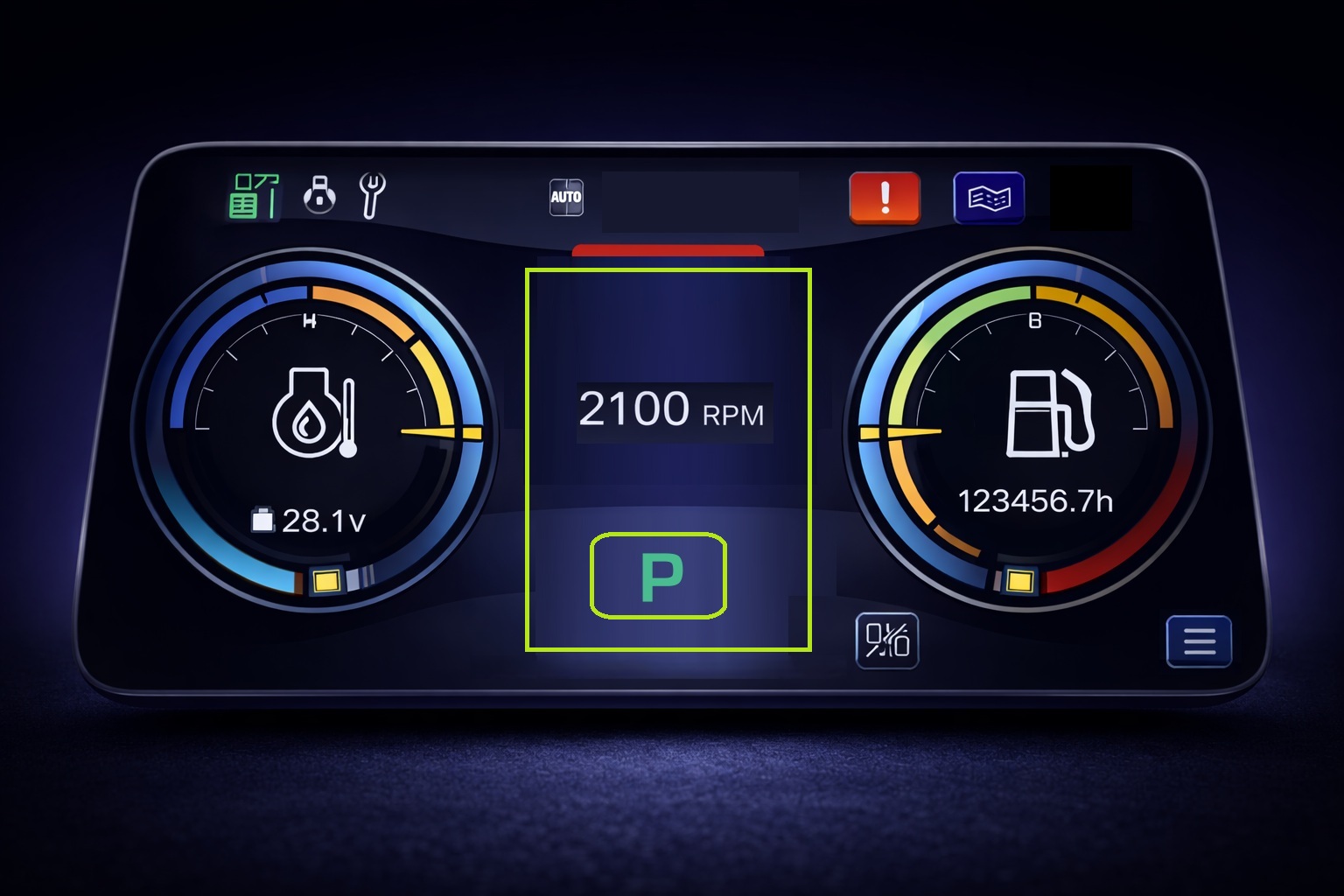
The main dashboard screen displayed critical machine data such as engine RPM, temperature, fuel level, warning indicators, gear position, operational mode, time, and date. Smooth needle animations were implemented using optimized interpolation methods to ensure stable and jitter-free gauge movement.
The Pre-defined Monitoring screen provided structured visibility into core system parameters including engine speed, coolant temperature, oil pressure status, and battery voltage. This allowed operators to quickly verify machine health. The Self-defined Monitoring feature allowed customization of monitored parameters. This flexibility enabled OEM-level configuration and future scalability.
The Maintenance Record screen tracked service intervals and previous change records for air cleaners, coolant, fuel pre-filters, engine oil, and oil filters. Engine hour tracking was integrated to ensure accurate service reminders. Sparklet’s text rendering engine ensured crisp typography and structured tabular layouts.
The Service Menu acted as a centralized navigation hub, allowing users to switch between monitoring modes, abnormality records, and maintenance logs. Smooth menu transitions were implemented using Sparklet’s animation capabilities, providing a modern and intuitive feel.
Abnormality Record management ensured that fault conditions were logged and displayed clearly. Warning icons were rendered with priority-based layering, ensuring immediate visibility during critical events.
Flint IDE played a crucial role in accelerating UI development. Designers created pixel-perfect screen layouts optimized for the 7-inch TFT LCD. Flint’s export pipeline seamlessly converted visual designs into Sparklet-compatible runtime assets, reducing integration effort and development time.
The overall architecture separated machine data acquisition, UI logic, and rendering layers. This modular approach enhanced maintainability and simplified feature upgrades.
Performance and Reliability
The excavator digital cluster demonstrated stable and reliable performance on the RH850 platform. Sparklet’s optimized rendering ensured smooth animations while maintaining low CPU utilization.
The system maintained consistent frame updates for gauges and dynamic values without flickering or visual artifacts. Boot time was optimized to ensure quick startup during machine ignition.
The 7-inch TFT LCD delivered high clarity, aided by carefully selected color themes and contrast optimization for outdoor visibility. The UI remained readable even in bright sunlight conditions.
Long-duration endurance testing confirmed stable operation under continuous runtime, vibration, and temperature variations typical of heavy equipment usage.
Business Impact
The implementation of a digital instrument cluster significantly enhanced the OEM’s excavator product line. The modern UI improved operator efficiency by presenting structured and accessible information. Maintenance tracking capabilities reduced downtime by enabling timely service interventions. The scalable architecture allowed easy adaptation across multiple excavator models. OEM customization and branding were seamlessly integrated through Flint’s design flexibility.
By leveraging Sparklet Embedded GUI on RH850, Embien ensured an optimal balance between performance, resource efficiency, and visual sophistication.
Conclusion
Embien successfully delivered a rugged and intelligent digital instrument cluster for excavators using the Renesas RH850 microcontroller, Sparklet Embedded GUI, and Flint IDE.
The solution combined real-time machine monitoring, maintenance tracking, and fault management into a cohesive and operator-friendly interface on a 7-inch TFT LCD. Through efficient rendering optimization and modular system design, Sparklet enabled a responsive, scalable, and production-ready cluster tailored for heavy construction environments.
This project demonstrates how advanced embedded GUI frameworks can transform traditional heavy equipment dashboards into modern digital control centers—enhancing reliability, usability, and operational efficiency in demanding field conditions.