Advanced Digital Instrument Cluster for Heavy Commercial Vehicles on NXP i.MX8 with Sparklet
Introduction
The commercial vehicle industry is rapidly transitioning from conventional analog dashboards to intelligent digital instrument clusters that enhance safety, efficiency, and driver awareness. Heavy-duty trucks, in particular, demand robust, real-time, and data-rich interfaces capable of handling multiple vehicle subsystems simultaneously. Modern fleet operations require detailed trip analytics, diagnostics, ADAS integration, and navigation support — all presented through a seamless and intuitive user interface.
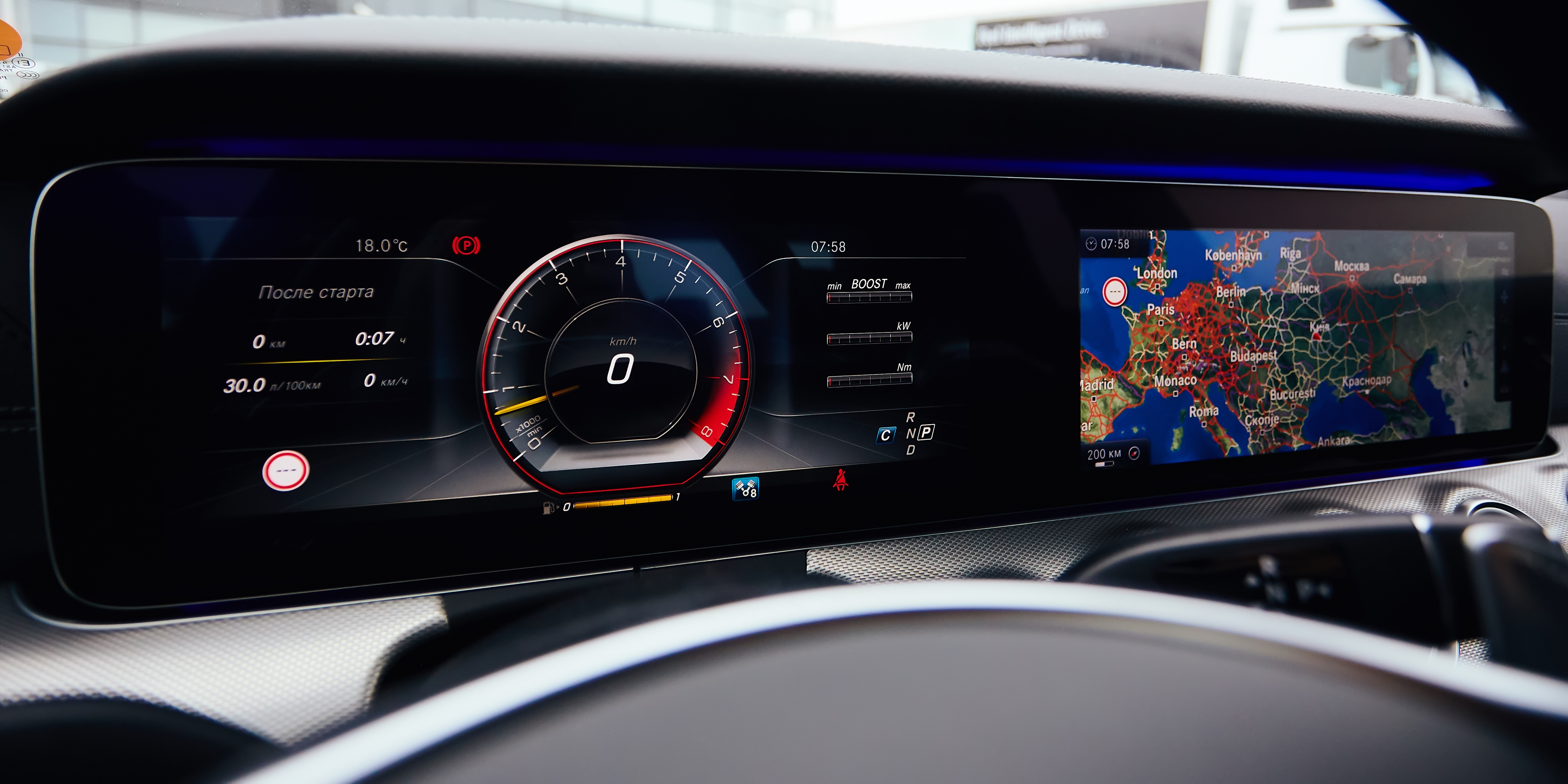
Embien Technologies collaborated with a leading heavy commercial vehicle manufacturer to design and develop an advanced digital instrument cluster built on the NXP i.MX8 platform. Running on a 10.25-inch TFT LCD with a resolution of 1920 × 720, the cluster was engineered using C and powered by Sparklet Embedded GUI, with UI design accelerated through Flint IDE. The result was a responsive, scalable, and production-ready cluster system tailored for demanding heavy vehicle environments.
Challenge
Developing a digital cluster for heavy-load commercial vehicles presents unique technical and operational challenges. Unlike passenger vehicles, heavy trucks require continuous monitoring of multiple performance parameters, safety indicators, and operational metrics. The cluster must process high volumes of real-time vehicle data from CAN and other communication interfaces while maintaining smooth animations and zero latency.
Another major challenge was managing a complex multi-screen interface. The system needed to support driving data, trip analytics, driver information screens, safety alerts, navigation overlays, diagnostic warnings, and customizable settings. Ensuring seamless screen transitions without frame drops or performance degradation was critical.
The large 10.25-inch display with a high resolution of 1920 × 720 demanded crisp graphics, fluid gauge animations, and excellent readability under varying lighting conditions. Heavy vehicle drivers rely heavily on visual clarity for safe operation, making UI responsiveness and contrast optimization essential.
Additionally, safety-critical features such as ADAS notifications, TPMS alerts, and driver monitoring warnings required prioritized rendering. These alerts needed to appear instantly without disrupting the core instrument display.
Balancing high graphical performance with efficient CPU utilization and stable long-term operation on the NXP i.MX8 platform was another key technical consideration.
Solution
Embien addressed these challenges by implementing a scalable and optimized digital instrument cluster architecture powered by Sparklet Embedded GUI. The system was developed in C and tailored specifically for the NXP i.MX8 application processor to leverage its processing and graphics capabilities effectively.
Sparklet served as the core runtime engine responsible for rendering all gauges, animations, overlays, and dynamic content. Its optimized rendering pipeline ensured that only the portions of the display that changed were redrawn, significantly reducing processing overhead while maintaining smooth frame rates. This intelligent redraw mechanism was especially beneficial for real-time gauge updates and animated transitions.
The user interface was designed using Flint IDE, allowing designers to create pixel-perfect layouts optimized for the 1920 × 720 resolution display. Flint streamlined the transition from design to deployment by exporting assets directly into Sparklet’s runtime format, minimizing integration effort and reducing development time.
Gauge animations such as speed, RPM, air pressure, fuel level, temperature, and DEF indicators were implemented using smooth interpolation techniques. Sparklet’s efficient rasterization and animation engine ensured fluid needle movements and consistent visual performance even during simultaneous data updates.
Safety and driver assistance features were integrated with priority-based rendering logic. ADAS screens, driver monitoring alerts, and TPMS warnings were designed to overlay critical notifications instantly without impacting the stability of background gauges. This ensured that safety alerts remained highly visible and responsive at all times.
Trip analytics, fuel economy calculations, driver rating insights, and histogram visualizations were dynamically rendered using Sparklet’s graphics primitives. The engine handled scaling, alpha blending, and text rendering efficiently, ensuring high readability across all screens.
Turn-by-turn navigation was seamlessly incorporated into the cluster layout. Navigation prompts were displayed without disrupting core driving information, maintaining a clean and organized interface structure.
The overall architecture was modular, separating data acquisition, UI logic, and rendering layers. This approach enhanced maintainability and allowed easy customization for different vehicle variants or feature upgrades.
Performance Outcomes
The digital instrument cluster demonstrated stable, real-time performance on the NXP i.MX8 platform. The system maintained consistent frame rates with smooth gauge transitions and rapid screen switching. CPU utilization was optimized through Sparklet’s intelligent rendering strategy, ensuring efficient processing even during high data activity.
The 1920 × 720 TFT LCD delivered crisp visuals and enhanced readability, providing drivers with a modern digital cockpit experience. Boot time was optimized to ensure quick system readiness, a critical requirement for commercial fleet operations.
The cluster operated reliably under continuous heavy-duty usage conditions, validating its suitability for commercial vehicle deployment.
Business Impact
The implementation of this advanced digital instrument cluster significantly enhanced the OEM’s vehicle offering. The modernized cockpit improved driver awareness and safety through real-time alerts and intelligent data visualization. Fleet operators benefited from improved trip monitoring and fuel efficiency insights, while the scalable architecture enabled future expansion of features.
By leveraging Sparklet Embedded GUI and Flint IDE, Embien reduced development complexity and accelerated time-to-market. The solution provided a flexible and customizable framework capable of adapting to evolving automotive requirements.
Conclusion
Embien successfully delivered an advanced digital instrument cluster for heavy commercial vehicles using the NXP i.MX8 platform, Sparklet Embedded GUI, and Flint IDE. The system combined smooth real-time graphics, intelligent safety integration, and efficient performance optimization on a high-resolution 1920 × 720 display.
This project demonstrates how modern embedded GUI technologies can transform heavy-duty vehicle dashboards into intelligent, connected, and visually engaging digital cockpits. By combining platform-specific optimization with a powerful graphics engine, Embien enabled a robust and scalable cluster solution designed for the next generation of commercial vehicles.