Advanced Digital Instrument Cluster for Electric Passenger and Commercial Vehicles Powered by RH850 with Sparklet
Introduction
With the rapid adoption of electric mobility, passenger and commercial vehicles are evolving to incorporate advanced digital interfaces that provide drivers with clear visibility into vehicle performance and battery health. Unlike conventional dashboards, electric vehicle instrument clusters must present a wide range of parameters including battery state, energy flow, power usage, and thermal management information in real time. Delivering this information through an intuitive and responsive interface is critical for ensuring safe and efficient vehicle operation.
A leading automotive OEM approached Embien Technologies to develop a next-generation digital instrument cluster for its electric passenger and commercial vehicle platform. The objective was to create a visually rich and highly responsive driver interface capable of presenting key EV metrics while maintaining reliability and efficiency on an embedded hardware platform.
The cluster was designed to run on the Renesas RH850 microcontroller and displayed on a 10.2-inch TFT LCD panel, offering a wide viewing area for multiple gauges, indicators, and system notifications. The system needed to seamlessly integrate vehicle parameters such as speed, power consumption, battery state of charge, energy efficiency, thermal conditions, and drive mode indicators, while ensuring clear readability under varying driving conditions.
To achieve this, Embien implemented a modern digital cluster architecture powered by Sparklet Embedded GUI, enabling smooth graphics rendering, efficient data visualization, and responsive user interactions. The solution delivers a comprehensive driver interface tailored for electric passenger commercial vehicles, combining real-time monitoring with a clean and intuitive display layout.
System Overview
The EV instrument cluster is built around the RH850 automotive microcontroller, known for its reliability and real-time processing capabilities in safety-critical automotive environments.
The cluster is displayed on a 10.2-inch TFT LCD, providing sufficient screen real estate to present multiple vehicle parameters simultaneously while maintaining clear readability for the driver.
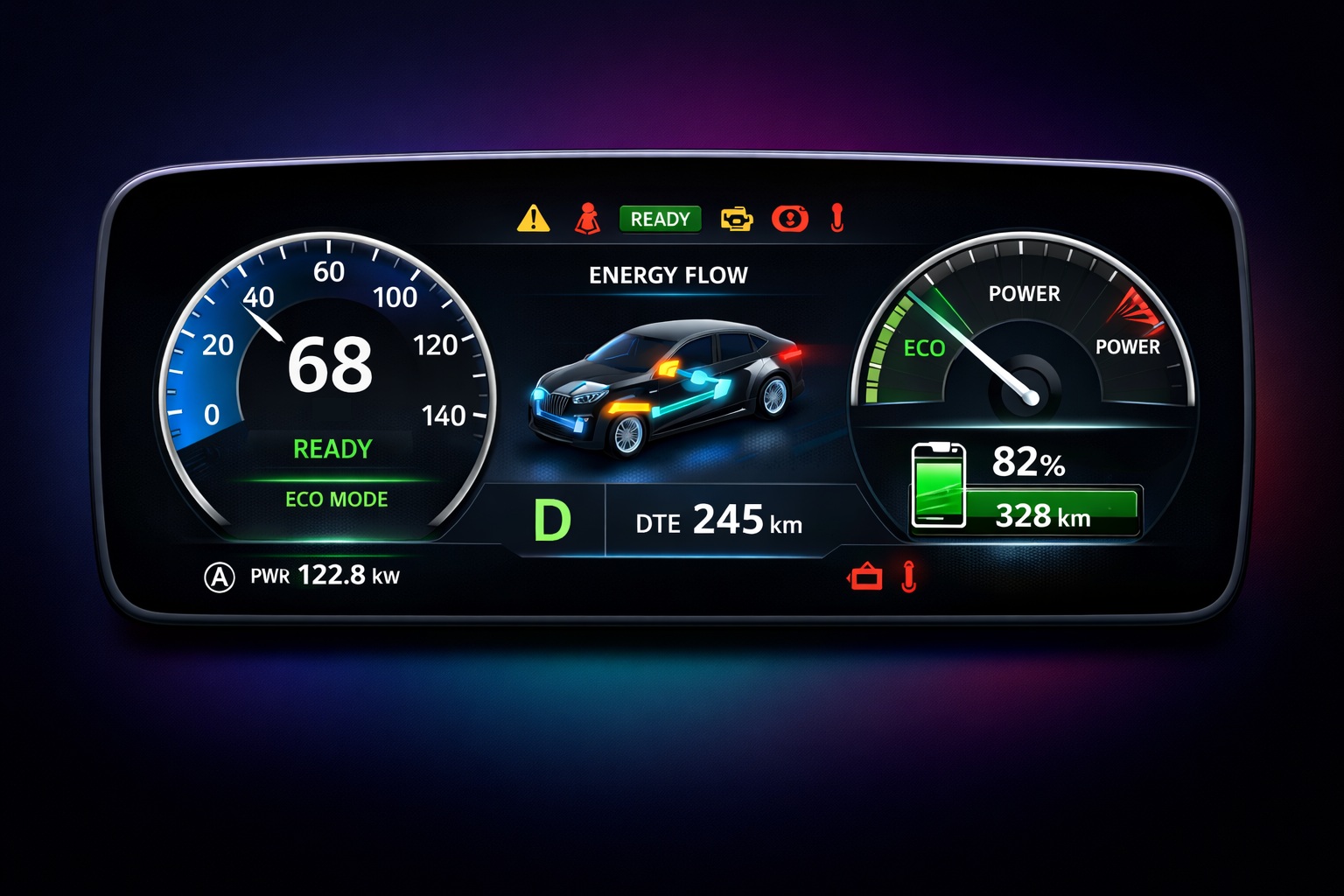
The interface combines analog-style gauges with digital indicators to present both traditional vehicle information and EV-specific data. Drivers can easily track speed, power usage, battery status, temperature levels, and other operational metrics through a structured layout that minimizes distraction. The system also supports multiple operational screens, including energy flow visualization, charging status, and driving mode selection.
Functional Features
The digital instrument cluster is designed to provide drivers with comprehensive visibility into vehicle performance, battery status, and operational efficiency. Built for electric passenger commercial vehicles, the system combines traditional vehicle gauges with advanced EV monitoring capabilities to ensure safe and efficient driving.
- Vehicle Performance Gauges : The cluster integrates essential gauges that allow the driver to monitor vehicle performance in real time. These include a speedometer for vehicle speed display, a power gauge indicating energy consumption and regenerative braking activity, and temperature indicators for monitoring both battery coolant and main coolant levels. These gauges help drivers understand vehicle performance and ensure optimal operation during different driving conditions.
- Driving Mode Indication: Electric passenger commercial vehicles often support multiple driving modes designed to optimize energy usage and vehicle performance. The instrument cluster provides clear visual indication of the selected drive mode, allowing drivers to adapt the vehicle behavior based on operating conditions such as city driving, efficiency mode, or high-load scenarios.
- Gear Position Display: The system displays the current gear selection, enabling drivers to clearly identify whether the vehicle is in drive, neutral, reverse, or parking mode. This feature is particularly important in larger passenger vehicles where operational clarity and safety are essential.
- Distance to Empty (DTE): The cluster includes a Distance to Empty (DTE) indicator that estimates the remaining driving range based on the current battery state and power consumption patterns. This feature assists drivers in planning routes and ensuring that sufficient energy remains to reach the next charging point.
- Battery Monitoring: A critical component of any electric vehicle cluster is battery monitoring. The system displays key battery parameters such as high-voltage battery state of charge (SOC), battery state of health (SOH), and battery voltage levels. In addition, the cluster also presents low-voltage battery status to ensure that all electrical subsystems are operating correctly.
- Energy Flow Visualization: To help drivers understand how energy is being used within the vehicle, the cluster provides a graphical representation of energy flow between the battery, motor, and drivetrain. This visualization highlights power consumption during acceleration and regenerative energy recovery during braking.
- Efficiency and Power Indicators: The cluster includes indicators that provide real-time insights into vehicle energy efficiency. These metrics help drivers adopt driving patterns that maximize battery range and optimize overall vehicle performance.
- Charging Status Interface: When the vehicle is connected to a charging station, the cluster transitions to a charging display mode. This screen shows the charging progress, battery charge percentage, and estimated range after charging completion. This information allows drivers and operators to monitor charging status conveniently.
- System Alerts and Safety Indicators: The instrument cluster continuously monitors critical vehicle parameters and displays alerts when abnormal conditions are detected. These alerts may include battery warnings, temperature alerts, or system fault notifications. Important warnings are prioritized to ensure they are immediately visible to the driver.
Challenge
Designing a digital instrument cluster for electric passenger and commercial vehicles presents several technical challenges. Unlike conventional clusters, EV dashboards must handle a wide range of real-time data such as battery status, power consumption, regenerative braking information, and system warnings.
One of the primary challenges is ensuring smooth graphical performance on resource-constrained automotive microcontrollers. The UI must render multiple gauges, animations, and alerts without affecting responsiveness or system reliability.
Another key challenge is integrating the UI with vehicle communication protocols, particularly CAN and other automotive interfaces, to receive and display real-time data accurately. Additionally, the cluster must meet strict automotive safety, reliability, and boot-time requirements, ensuring that critical information is available instantly when the vehicle starts.
Finally, the design must maintain clarity and readability in various lighting conditions, ensuring drivers can quickly understand vehicle status while minimizing distractions.
Solution
To address these challenges, Embien implemented a high-performance digital instrument cluster solution powered by the Renesas RH850 microcontroller and Sparklet UI framework.
The cluster UI was developed using Sparklet, enabling the creation of visually rich dashboards while maintaining optimized memory and CPU usage. The framework’s lightweight architecture ensured smooth animations, responsive transitions, and efficient rendering suitable for embedded automotive hardware.
The system architecture was designed to seamlessly integrate with the vehicle’s communication stack, allowing real-time data from the ECU to be displayed instantly on the cluster. Sparklet’s flexible UI design capabilities enabled the development of dynamic gauges, warning indicators, and contextual alerts that adapt to different vehicle operating conditions.
Additionally, the UI design focused on clear visual hierarchy and intuitive layouts, ensuring drivers can quickly interpret critical information such as speed, battery status, and system alerts.
Performance and Results
The final solution delivered a highly responsive and visually engaging digital instrument cluster optimized for electric passenger and commercial vehicle applications.
The integration of Sparklet with the Renesas RH850 platform enabled smooth rendering of complex graphical elements, including animated gauges and real-time indicators, without compromising system stability.
The cluster demonstrated fast boot times, efficient resource utilization, and reliable real-time data updates, meeting the performance expectations required for automotive deployments. The optimized UI architecture ensured the system maintained consistent responsiveness even when displaying multiple data elements simultaneously.
Overall, the solution proved capable of delivering modern digital dashboard experiences on embedded automotive hardware, combining performance, reliability, and scalable UI design.
Conclusion
The development of an advanced digital instrument cluster for electric passenger and commercial vehicles highlights the importance of combining powerful automotive hardware with optimized embedded UI frameworks.
By leveraging the Renesas RH850 microcontroller and Sparklet UI framework, Embien successfully created a digital cluster that balances performance, visual quality, and system efficiency. The solution demonstrates how modern embedded UI technologies can enable intuitive and responsive dashboards while meeting the strict reliability requirements of automotive environments.
This approach provides a scalable foundation for next-generation electric vehicle clusters, enabling OEMs to deliver rich driver experiences while maintaining robust embedded system performance.