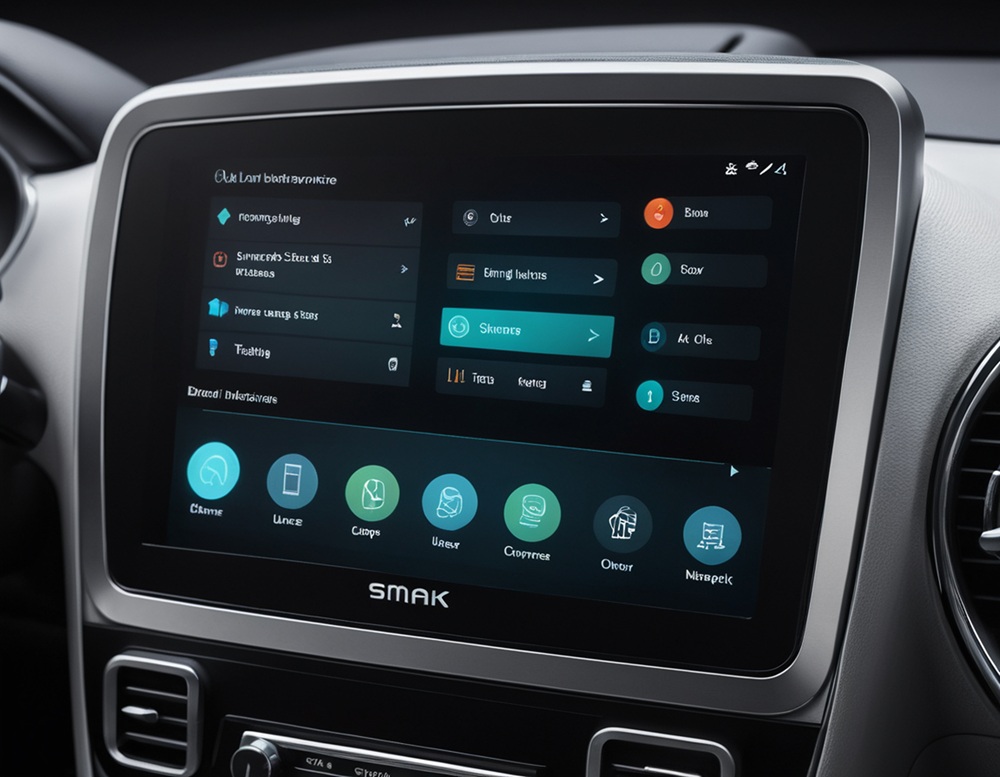
The world of embedded systems has witnessed a dramatic evolution. Gone are the days when a blinking LED and a 7-segment display were sufficient. Today, users expect the same rich, responsive, and intuitive graphical user interfaces (GUIs) they have on their smartphones and tablets, even on their refrigerators, medical devices, and industrial controllers.
This expectation presents a significant challenge. Unlike PCs or mobile phones, embedded systems are almost always resource-limited. We are in a constant battle with constrained MCUs, limited RAM, and minimal flash memory. The central question for embedded UI developers is no longer "Can we build a GUI?" but "Can we build a beautiful, dynamic, and modern GUI without crippling our system's performance?"
In our journey to solve this exact problem, we’ve found that the answer lies not in brute-force hardware, but in a smarter software architecture. The cornerstone of this modern approach is multi-layer widgets. This architectural concept is the secret to creating rich, editable, and elegant UIs that run efficiently, and it’s a principle we’ve baked into the very core of our Sparklet Embedded Graphics Library.
Beyond the Monolith: What is Widget Layering?
To understand the power of widget layering, let’s first discard the "old way." Traditionally, an "image widget" could only hold an image. A "text widget" could only hold text. This monolithic approach is rigid and forces developers to create complex, custom widgets for even slightly different combinations.
Multi-layer widgets, the core principle of Sparklet's architecture, completely change this. We treat every single widget not as a fixed-function object, but as a collection of layers. A widget is a "host" or a "container" that can have multiple layers added to it, stacked one on top of the other like semi-transparent slides.
This means a single widget can be composed of multiple, different layer types to create a new, compound visual.
Let's take a simple Image Holder widget from the Sparklet UI designer. In its basic form, it has one Image layer. But with the power of widget layering, you can add more layers to that same widget:
- Want a caption? Add a Display Text layer on top of it.
- Want to show a "disabled" state? Add a FillColor layer on top with a 50% transparent gray.
- Want to draw a dynamic border? Add a Fill Shape (Rectangle) layer around the edge.
Suddenly, your simple Image Holder is a complex, dynamic "Labeled Status Image" widget. This ability to mix and match layers within a single widget—combining FillColor, Image, Display Text, and Fill Shape layers—is the secret to creating rich, dynamic, and editable UIs with unprecedented flexibility.
The Sparklet Approach: Widget Layers as Atomic Units
Our Sparklet Embedded Graphics Library was designed from the ground up on this principle. The Sparklet UI designer treats every single widget as a collection of layers. This granular control allows developers to create visually stunning and highly dynamic widgets that are incredibly lightweight.
When a widget is rendered, it’s a runtime combination of these layers, stacked from bottom to top. This allows for powerful editing, animation, and data-binding. Sparklet supports a versatile set of layer types, each optimized for a specific job:
- FillColor Layer: The simplest layer. Its job is to fill the widget's area with a single solid color (or a color with an alpha channel for transparency). This is perfect for widget backgrounds, overlays, or simple status indicators.
- Image Layer: This layer draws a bitmap image. It's the workhorse for icons, logos, or complex, static background graphics where a shape or color won't suffice.
- Display Text Layer: Renders text strings using specific fonts, colors, and alignments. This is crucial for displaying dynamic data, labels, and user information.
- Fill Shape Layer: This is where the true dynamic power comes in. This layer can draw primitive shapes—like rectangles, triangles, quadrilaterals, ellipses, circles, and arcs—at runtime. Crucially, these shapes can be drawn with fill colors, gradients, and their properties (like position, size, or angle) can be changed on the fly.
Use Cases: From Simple Icons to Compound Widgets
This layer-based composition allows you to build complex UI elements from a single widget in the designer, drastically reducing complexity and memory footprint.
- Use Case 1: The Icon Button(Shape + Image + Text): A common need in UI design is a button that combines a background, an icon, and a text label. Traditionally, this required creating a composite image like button_with_icon_and_text.png in an external graphics tool, meaning any text change (e.g., “Play” to “Pause”) demanded a new image file. With Sparklet’s layered approach, a single Button widget can handle it all — a Fill Shape layer forms the button’s body, an Image layer adds the icon, and a Display Text layer shows the label. Each layer can be modified independently at runtime, allowing quick color, icon, or text updates. Even the pressed-state effect can be achieved by simply changing the Fill Shape’s color, eliminating the need for multiple image assets and saving flash memory.
- Use Case 2: The Data-Driven Status Indicator (Image + Text + FillColor): In devices like medical monitors, it’s often necessary to display a dynamic status icon — such as a heart symbol with live BPM readings and a warning overlay. Using Sparklet’s Image Holder widget, this can be achieved with just one element: the first layer holds the static heart icon, the second layer displays real-time BPM text bound to a variable, and the third FillColor layer overlays warning colors based on system status. When normal, the overlay remains transparent; when critical, it turns semi-transparent red, creating a clear visual alert. This approach transforms a simple image holder into a powerful, data-driven dashboard component with minimal resources.
- Use Case 3: The Runtime-Drawn Progress Bar (Shape + Shape + Text): For progress indicators, Sparklet allows you to build smooth, animated bars entirely through layered design. Using a single Container widget, the first Fill Shape forms the static background track, while the second represents the dynamic progress fill whose width is bound to a variable. A Display Text layer sits on top, showing the percentage in real time. This design not only eliminates image dependencies but also delivers an efficient, theme-able progress bar that updates smoothly with minimal CPU usage, as only the changing parts — the progress fill and text — are redrawn.
Unlocking Customization on Resource-Limited Systems
Multi-layer widgets are a game-changer in embedded GUI design, offering customization and efficiency that monolithic approaches cannot achieve.
- High Efficiency with Minimal CPU Load: In embedded systems, the most resource-intensive operation is updating the frame buffer. Traditional static images often require redrawing entire elements even for minor changes. Sparklet’s layered architecture solves this by enabling partial frame-buffer updates. For example, when a button’s state changes, only the affected FillColor layer is updated. The rendering engine calculates the minimal “dirty rectangle” to redraw, significantly reducing CPU usage and memory traffic. This approach allows smooth 60 FPS animations even on seemingly underpowered hardware.
- Seamless Theming for Light and Dark Modes: Switching themes becomes effortless with layers. A theme is simply a set of properties applied to the layers. For a light theme, FillColor layers might use light gray backgrounds (#E0E0E0) with dark text (#101010), while a dark theme uses dark gray backgrounds (#303030) and light text (#FAFAFA). Changing themes does not require reloading UI assets — the engine simply updates layer properties, delivering instant results without extra flash memory consumption.
Conclusion
Multi-layer widgets are not just a "feature"—they are a fundamental architectural shift in embedded GUI design. They move us away from rigid, static bitmaps and toward a dynamic, efficient, and object-oriented model. This approach is the only way to deliver the rich, smartphone-like experiences users demand on the power- and cost-constrained hardware that defines embedded systems.
By treating every widget as a collection of simple, independent layers, Sparklet gives developers fine-grained control over their UI. This control leads directly to higher performance, lower memory usage, and a level of customization and dynamic capability that was previously unthinkable on MCUs.
We've only scratched the surface of what this architecture enables. We strongly encourage our entire developer community—and anyone struggling to build modern UIs on embedded systems—to dive deeper.See for yourself how the layer types work and what properties you can control. Review the official Sparklet’s Widget Layers documentation and start thinking about how you can use this power in your next product design. https://sparkletui.com/flint-ui-designer